
-
Call Us Now
+256 414 540-410 or 080 0100800 -
Send Mail Us
emailus@uci.or.ug - GET IN TOUCH
UCI Radiation Oncology Fellowship Training
A 48-month specialist program designed to train competent, independent radiation oncologists while strengthening multidisciplinary cancer care in Uganda and the East Africa region.
Quick Facts
• Award: Fellowship in Radiation Oncology (F Rad Onc)
• Duration: 48 months
• Annual intake: up to 4 fellows (maximum 16 fellows in training)
• Oversight: UCI Department of Research and Training in collaboration with Ministry of Health, affiliated Universities, and the East Central Southern Africa College of Oncologists (ECSACO)
Program Overview
The UCI Fellowship in Radiation Oncology is designed to address critical workforce gaps in radiotherapy and advance high-quality, evidence-based oncology care in Uganda and the region.
Mission, Vision & Values
Purpose: Train and sustain a critical mass of highly trained radiation oncologists to mitigate cancer-related death and suffering.
Vision: Become an East Africa regional training center of excellence in Radiation Oncology.
Mission: Equip trainees to practice competently and independently within multidisciplinary cancer care.
Values:
• Professionalism
• Excellence and innovativeness
• Respect and equity
• Integrity and accountability
• Scientific evidence
• Empathy
Duration, Structure & Accreditation
• Length: 48 months of training.
• Assessment milestones: Part I (Primaries) by approximately 18 months; Part II by approximately 36 months, with written, oral, and practical components as applicable.
• Standards and compliance: Program leadership ensures alignment with local regulatory guidelines by the Uganda Medical and Dental Practitioners’ Council and Uganda Council for Higher Education requirements, as well as regional and international guidelines from partner colleges including the East Central Southern Africa College of Oncologists.
Program Objectives (selected)
• Increase the number of trained radiation oncologists for Uganda and East Africa.
• Strengthen multidisciplinary cancer care through specialist training.
• Grow oncology-related research output in the region.
Benchmarking & Global Alignment
The curriculum is informed by international and regional frameworks, including IAEA training resources (endorsed by ASTRO/ESTRO) and other established specialty curricula (e.g., RCR, RANZCR, ACGME and regional colleges).
Curriculum & Training
The fellowship integrates clinical apprenticeship, didactic learning, multidisciplinary practice, and research—producing graduates prepared for safe, ethical, and evidence-based radiation oncology practice.
Training System & Rotations
The training system spans clinical disciplines relevant to modern oncology practice and includes non-traditional domains such as management, research fundamentals, and communication.
Program Structure (high-level):
• Part I: Basic Sciences (e.g., radiology, applied anatomy, radiobiology, medical physics, nuclear medicine).
• Part II: Clinical Oncology blocks (e.g., GI, GYN, GU, head and neck, breast, thoracic, haematology, CNS, paediatric, palliative, electives, biostatistics).
Academic & Quality Learning Environment
• Monthly virtual case conferences (AFRONET) for external expert input.
• Weekly chart review supporting safe planning and collective decision-making.
• Weekly journal club reviewing recent trials and meta-analyses.
• Weekly academic seminar focused on case management and departmental protocols.
• Multidisciplinary tumor boards across key disease sites (e.g., head and neck, gynaecology, breast, urology, GI, paediatrics).
Assessment & Portfolio
Fellows maintain a learning portfolio documenting clinical experience and competency development, including a logbook and case reports across core disease sites.
• Portfolio is signed off by the Head of Department before Part II and presented during the oral exam.
• Includes broad disease-site coverage (e.g., breast, gynaecology, head and neck, GI, urology, respiratory, lymphomas, CNS, paediatrics/sarcomas).
• OSCE/practical examination includes multiple stations and a defined pass standard.
Research Training
Research competency is integrated through structured learning and critique, including a required statistical critique of a published article after Part I examinations.
• Research blocks are included in the training structure.
• Opportunities for mentorship and collaborative research through multi-institutional partnerships.
Eligibility & Application
The program welcomes qualified Ugandan and international applicants, with a structured intake to ensure high-quality clinical supervision.
Eligibility Requirements
• MBChB (or equivalent medical degree).
• MMed in any clinical discipline (or equivalent medical degree).
• Registration with the Uganda Medical and Dental Practitioners’ Council.
• At least 12 months of direct patient care in a core clinical discipline.
• Annual intake: up to four fellows per year (maximum 16 fellows in training).
Application Process
1. Review eligibility and program details.
2. Prepare required documents: [CV, academic transcripts, registration/license, letters, etc.].
3. Submit application via the portal (or in-person submission where applicable).
4. Shortlisting and interview.
5. Offer letter and onboarding/induction.
Fees & Sponsorship
The program is primarily privately sponsored and self-supporting through tuition fees, with some trainees qualifying for government (UCI) sponsorship.
Tuition (per year):
• Ugandans: UGX 7,000,000
• Non-Ugandans: USD 5,000
Other Fees (examples):
• Application fee: UGX 50,000
• Registration fee: UGX 120,000
• Examination fees: UGX 200,000
Faculty & Mentorship
Fellows learn within a multidisciplinary faculty model, supported by program leadership and partner institutions.
Program Leadership & Oversight
• Programme Director: accountable for administration, structure, and compliance with national requirements.
• Quality assurance support: oversight mechanisms to maintain training quality.
• Collaborative governance: UCI Department of Research and Training in collaboration with Ministry of Health, and ECSACO.
Faculty Team
Faculty include radiation oncology, medical physics, medical oncology, and allied disciplines. Examples:
• Radiation Oncology teaching staff (UCI) including:
• Dr. Israel Luutu
• Dr. Daniel Kanyike
• Dr. Solomon Kibudde
• Dr. Geraldine Kauma
• Dr. Hanifah Nalunga
• Medical Physics teaching staff including:
• Dr. Awusi Kavuma
• Dr. Ignatius Komakech
• Mr. Moses Fredrick Katumba
• Mr. Bonny Abal
• Mr. Alen Musisi
• Mr. Apollo Muramuzi
• Medical Oncology teaching staff including:
• Dr. Jackson Orem
• Dr. Victoria Walusansa
• Dr. Henry Ddungu
• Dr. Fred Okuku
• Dr. Alex Bakenga
• Dr. Joanne Kayaga
• Dr. Naghib Bogere
• Radiation Therapy (RTT) staff including
• Ms. Cissy Bangidde Namutale
• Mr. Martin Seguya
• Mr. Ali Senabulya Lubowa
• Mr. Karim Mawerere
• Ms. Catherine Nakato
• Mr Noah Ggayi
Mentorship Model
Mentorship is delivered through supervised clinical apprenticeship, structured academic activities (chart rounds, seminars, journal clubs), and external expert engagement through partner-supported conferences and visiting expertise. We encourage a peer-to-peer, and peer-to-faculty mentorship model.
Facilities & Resources
Fellows train in an environment designed to support safe clinical practice, modern radiotherapy workflows, and academic learning.
Training Spaces
• Lecture rooms, board rooms, and conference rooms with audiovisual support.
• Tutorial rooms and clinical consultation space.
• Dedicated fellows’ room and a reference library.
Radiotherapy Technology & Labs
• Varian TrueBeam linear accelerator (photon and electron energies).
• HDR brachytherapy afterloader (intracavitary, interstitial, intraluminal, cylinders).
• CT simulator supporting 3D-CRT, IMRT, SBRT, SRS planning.
• Treatment planning system (Eclipse, and SagiPlan).
• Physics laboratory (equipment available); radiobiology lab under construction.
• Radiation safety officer and monitoring badge system.
External Support & Learning Resources
The program leverages external support (e.g., IAEA projects) to strengthen training through expert support, library development, QA/QC equipment, and external examination processes.
Partners/collaborators include:
• East Central Southern Africa College of Oncologists (ECSACO)
• Imperial College Healthcare NHS Trust, UK.
• Medical College of Wisconsin
• Mulago National Specialised Hospital
• University of Washington, USA
• Fred Hutch Cancer Research Centre, USA
• Baylor College of Medicine, USA
Fellowship Experience
Fellows develop competence through supervised clinical service, multidisciplinary tumor boards, structured academic time, and mentored research—while contributing to national and regional cancer care delivery.
Clinical Apprenticeship
Progressive responsibility with close supervision, emphasizing safe treatment decision-making, planning quality, and toxicity management.
Case-based learning: weekly chart review and protocol-driven seminars.
Multidisciplinary Practice
Participation in disease-site MDTs/tumor boards (e.g., head and neck, urology, gynaecology, breast, GI, paediatrics).
Scholarly Development
Weekly journal clubs focused on recent trials and meta-analyses to support evidence-based practice.
Career Pathways
• Consultant Radiation Oncologist roles in Uganda and the region
• Academic faculty and fellowship leadership tracks
• Subspecialty focus areas: gynaecological oncology, breast, head and neck, paediatrics, palliative radiotherapy, etc.
• Clinical research and implementation leadership roles
Impact & Outcomes
The fellowship is designed to expand the specialist workforce, strengthen multidisciplinary oncology care, and increase research output for Uganda and East Africa.
Workforce Growth
Training targets a sustained increase in trained radiation oncologists for Uganda and neighboring countries.
Quality & Safety Culture
Structured review systems (chart review, case conferences) promote safe, high-quality radiotherapy practice.
Research & Leadership
Research blocks and structured critique build clinician-scientist skills and support regional oncology evidence generation.
Trainee Spotlight
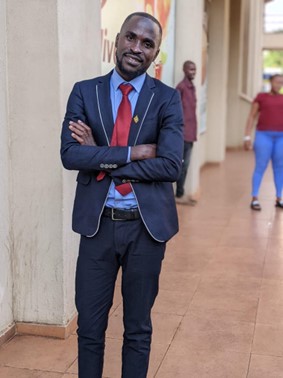
Here below are the current trainees
Figure 1 – Dr Richard Komakech (1st Cohort)
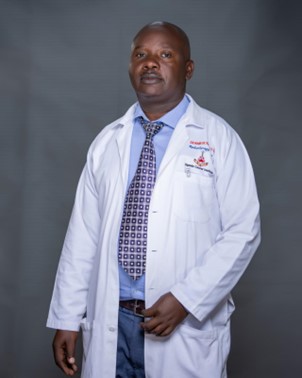
Figure 2 – Dr Friday Odala (2nd Cohort)

Figure 3 – Dr Derick Zake (3rd Cohort)
Contact & Application Portal
Use the links below to begin your application or reach the program office for guidance.
Apply Online
Application portal: [email to – charity.kobusingye@uci.or.ug and cc – nixon.niyonzima@uci.or.ug, solomon.kibudde@uci.or.ug and radiotherapy@uci.or.ug ]
Contact
Program Office: UCI Division of Radiation Oncology
Email: radiotherapy@uci.or.ug
Phone:
Address:
Figure 4 Program Director – Dr Solomon Kibudde
FAQ
• How long is the fellowship?
48 months.
• How many fellows are admitted each year?
Up to four fellows annually (maximum 16 fellows in training).
• What are the minimum eligibility requirements?
MBChB (or equivalent), national registration, and at least 12 months of direct patient care (or equivalent specialist training).
• What technology will I train on?
Training includes modern platforms such as a TrueBeam linac, HDR brachytherapy, 3D & 4D CT simulation, and Eclipse treatment planning for 2D, 3DCRT, IMRT, VMAT, SRS / SBRT techniques.